How to Choose the Best Window Tint Percentage for Maximum ROI

May 26, 2025
Introduction

When it comes to window tinting, most people focus on how dark or stylish the film looks—but there’s more to it than just aesthetics. The percentage of your window tint plays a crucial role in how effective it is, how comfortable your ride feels, and ultimately, how much value it adds to your investment. In fact, selecting the right window tint percentage can directly impact your return on investment (ROI)—from better resale value to reduced energy costs and long-term interior protection.

Window tint percentage refers to the amount of visible light transmission (VLT) allowed through the glass. The lower the percentage, the darker the tint. While a 5% limo tint might offer maximum privacy, it could hurt visibility and even violate local laws. On the flip side, a 70% tint is nearly transparent, offering UV protection without changing the car’s appearance much. So, how do you choose the right level of tint to get the best performance and value?

Whether you’re tinting a personal car, applying residential window tint to your home, or considering commercial window tint for a fleet, finding the ideal balance between comfort, legal compliance, and style is key.

In this article, we’ll break down everything you need to know to make the smartest decision—from understanding tint percentages and legal limits to evaluating privacy needs, aesthetics, and ROI. By the end, you’ll have a clear picture of which tint percentage delivers the most value for your needs—both now and in the long run.

What Is Window Tint Percentage?

When people talk about window tint, one of the most important—and often misunderstood—terms is “tint percentage.” This number refers to Visible Light Transmission (VLT) , or the percentage of light that is allowed to pass through the window after the film is applied.

The scale works like this: the lower the percentage, the darker the tint. For example, 5% window tint—commonly known as “limo tint”—blocks 95% of visible light, allowing only 5% to pass through. It offers maximum privacy and a dramatic look, but it can make night driving more difficult and may not be legal in many areas. On the other end of the spectrum, a 70% tint is very light—barely noticeable—but still provides benefits like glass protection and UV filtering.

Understanding window tint percentage is essential when trying to balance style, function, and legality. While darker tints may look more appealing or offer greater heat rejection, they can also reduce visibility and potentially violate tint laws depending on your state or region.

This concept doesn’t apply only to cars. Residential window tint and commercial window tint use the same percentage principles, helping property owners control sunlight, reduce glare, and improve energy efficiency—without making windows too dark.

Knowing what tint percentage means gives you a foundation for making smarter decisions. Whether you’re upgrading your personal car or managing a fleet of commercial vehicles, selecting the right tint percentage can enhance comfort, privacy, and resale appeal—while still staying within legal limits.

Up next, we’ll dive deeper into what ROI really looks like in the world of tinting—and why percentage choice plays a bigger role than you might think.

Understanding ROI: More Than Just Cost Savings

When most people think about return on investment (ROI), they tend to focus strictly on how much money they’ll save. But with window tint, ROI is about more than just reducing glare or trimming your energy bill—it’s about long-term value, comfort, and protection.

Installing the right window tint can increase the resale value of your vehicle or property, extend the life of interior materials, and reduce the strain on cooling systems. These benefits may not show up in your bank account right away, but over time, they contribute to savings and increased appeal—especially when you’re ready to sell or trade in.

For example, tinting your car with a high-quality film that blocks UV rays and heat can protect the dashboard, seats, and trim from fading or cracking. That preservation alone can help a car look newer for longer, translating into a better resale price. Similarly, residential window tint can help homeowners reduce heat intrusion and protect flooring and furniture from sun damage, all while lowering energy bills.

The percentage of tint you choose plays a major role in your ROI. A film that’s too light may not offer the level of glass protection or comfort you’re aiming for, while a film that’s too dark might violate local laws or hurt visibility—both of which could end up costing you more in the long run.

Commercial window tint offers ROI in fleet protection, consistent appearance, and improved working conditions. Whether you’re investing in your car, home, or business, selecting the right tint percentage ensures you’re not just spending—you’re investing wisely.

Next, we’ll cover how staying within legal limits can directly affect both your ROI and your peace of mind.

Legal Tint Limits: Avoiding Costly Mistakes

Choosing the right window tint percentage isn’t just about comfort or aesthetics—it’s also about staying within the law. Each state, and sometimes even individual cities, has specific regulations for Visible Light Transmission (VLT) percentages. Failing to comply with these laws can result in citations, fines, and even required tint removal—all of which chip away at your return on investment.

For example, while 20% tint might be perfectly legal on rear windows in one state, it could be illegal on front side windows in another. Some regions also have stricter limits for vehicles like SUVs and trucks versus passenger cars. The cost of re-tinting or paying tickets quickly outweighs any short-term benefit of going darker than allowed.

Many car owners unknowingly make the mistake of choosing overly dark tint based on looks alone, only to find themselves in trouble during inspections or roadside stops. Worse yet, potential buyers may shy away from purchasing a vehicle with illegal or questionable tint, reducing your resale potential.

That’s why it’s important to work with a professional installer who understands local tint laws and can guide you in choosing a legal yet effective percentage. Whether it’s for a personal car, residential window tint, or commercial window tint, compliance ensures your tint adds value—not problems.

In some cases, lighter films with advanced technology (like ceramic tints) can offer high heat and glass protection benefits while still meeting VLT requirements. It’s the best of both worlds—performance and legality.

Staying informed and compliant ensures that your tint investment continues to pay off, without the risk of legal setbacks.

Up next, we’ll explore how different percentages affect heat rejection and UV protection—key elements in maximizing ROI.

Heat and UV Rejection: Finding the Balance

One of the main reasons people invest in window tint is to block out heat and harmful ultraviolet (UV) rays. These are more than comfort concerns—they directly affect the long-term condition of your vehicle or property and, ultimately, your return on investment.

High-quality tint can reject up to 99% of UV rays and a significant amount of infrared heat. This translates to a cooler interior, less reliance on air conditioning, and reduced fading or cracking of interior surfaces. Over time, this level of glass protection helps preserve upholstery, dashboards, and electronics—making your vehicle or building look better and last longer.

The tint percentage you choose plays a big role in how much heat and UV rejection you’ll get. Generally, lower VLT percentages (darker tints) block more light and heat. For example, a 15% tint typically provides more sun protection than a 50% tint. However, that doesn’t mean darker is always better. Modern ceramic and infrared-blocking tints can offer excellent heat and UV resistance even at lighter shades—making them ideal for people who want performance without heavily darkened windows.

Whether you’re applying residential window tint to reduce heat in your home, or commercial window tint to protect office interiors and improve energy efficiency, choosing a film that balances performance with legal visibility is key.

For vehicles, selecting a tint that offers high heat rejection without impairing visibility or violating local laws delivers the best long-term ROI. It improves comfort, protects your investment, and saves money over time.

Finding the right balance between performance and compliance helps you get the most out of your tint—without sacrificing practicality or protection.

Next, we’ll look at how tint percentage affects visibility and what that means for driving safety.

Visibility and Driving Safety

While window tint offers numerous benefits, one factor that should never be overlooked is visibility—especially at night. Selecting a tint percentage that enhances comfort without compromising safety is crucial, not only for your driving experience but also for maintaining the long-term value of your vehicle.

Lower tint percentages, like 5% or 15%, are great for privacy and heat reduction but can significantly reduce visibility during evening and nighttime driving. This can create blind spots or make it harder to see pedestrians, cyclists, or road hazards—potentially increasing the risk of accidents. Not only is this dangerous, but a vehicle with an overly dark or unsafe tint can be harder to sell or pass inspection.

Many drivers find the sweet spot between safety and performance falls between 20% and 35% . These mid-range percentages still block a good amount of sunlight and heat while maintaining clear visibility in most conditions. Plus, they often stay within the legal limits in many states, further protecting your investment.

Professional installers can also help recommend films that offer strong glass protection and UV rejection, even at higher (lighter) VLT percentages. This is especially useful for drivers who prioritize both safety and long-term value.

Visibility is equally important in residential window tint and commercial window tint, where choosing the wrong shade can block natural light and create dim interior spaces. Just like in vehicles, balance is key.

Ultimately, choosing a tint that supports safe driving builds buyer confidence and contributes to your car’s resale appeal. A comfortable, stylish, and safe driving experience is something nearly every buyer is willing to pay more for.

Next, we’ll explore how different tint percentages impact privacy—and how to find the right fit for your lifestyle.

Privacy vs. Practicality

Privacy is one of the top reasons people choose window tint, but it’s important to balance it with practical considerations like visibility, legality, and day-to-day usability. Going too dark might offer maximum privacy, but it can also reduce visibility, draw unwanted attention, or even lead to legal trouble—especially if it exceeds local VLT limits.

Low-percentage tints like 5% or 15% are great for keeping prying eyes out, which is why they’re commonly used on rear windows or by individuals who prioritize privacy—such as rideshare drivers, parents with young children, or those carrying valuable equipment. However, these darker tints may not be legal on front side windows in many states and can limit visibility at night, particularly in poorly lit areas.

If you’re looking for a balance between privacy and everyday function, mid-range options like 20% to 35% often provide the best of both worlds. They still reduce visibility into your vehicle during the day while offering better drivability and compliance with tint regulations.

The same concept applies to residential window tint and commercial window tint. Homeowners may prefer darker tints for bedrooms or street-facing windows, while lighter films may be more suitable for living spaces that benefit from natural light. Commercial buildings often use tinting for both privacy and professionalism—especially in offices or storefronts.

Ultimately, your ideal tint percentage will depend on your lifestyle and use case. Think about where you drive, park, and live—and weigh the need for privacy against safety, comfort, and lawfulness. With the right balance, your tint can provide discretion without limiting function, helping you get the best return on your investment.

Next up, we’ll look at how tint percentage plays into your vehicle’s overall style and visual appeal.

Aesthetic Considerations and Vehicle Style

While functionality is key, there’s no denying that window tint also plays a big role in a vehicle’s visual appeal. The right tint percentage can give your car a sleek, uniform appearance that elevates its overall style—without needing expensive modifications.

Darker tints, such as 15% or 20%, often offer a more aggressive, high-end look. They tend to create contrast with lighter paint colors and help hide interior clutter, giving the vehicle a cleaner profile. For some drivers, this sharp appearance is a primary reason for tinting—and when done right, it can boost the resale appeal by making the car look newer and more polished.

That said, not every vehicle benefits from a dark tint. Lighter shades like 35% or 50% may be better suited to luxury sedans or vehicles with darker paint, where the goal is subtle enhancement rather than bold contrast. These higher percentages can still provide glass protection and UV rejection without dramatically altering the vehicle’s natural aesthetic.

It’s also worth considering the effect of tint on chrome, trim accents, and wheel finishes. The tint percentage you choose should complement these elements—not overpower them.

The same design considerations apply to residential window tint and commercial window tint. For example, modern homes may look best with a neutral or reflective tint, while businesses might opt for darker films to maintain privacy and a professional edge.

Whether you’re trying to create a sporty look, maintain elegance, or simply enhance uniformity, choosing the right tint percentage makes a difference in style and perceived value. A visually cohesive exterior increases curb appeal—and can be just the edge needed when it’s time to sell or trade in.

Next, we’ll break down the best tint percentages by vehicle type to help you make a more tailored choice.

Best Tint Percentage by Vehicle Type

When choosing the best window tint percentage, it’s important to consider the type of vehicle you’re working with. What works for a compact sedan may not be ideal for an SUV, truck, or commercial vehicle. Tailoring your tint selection by vehicle type ensures better comfort, functionality, and visual appeal—while maximizing return on investment.

Sedans and Coupes: For most personal cars, a 20% to 35% tint on side and rear windows strikes a great balance between privacy, heat rejection, and legal compliance. It adds a sleek look without making visibility a challenge. If your sedan already has factory-tinted glass, you might opt for a slightly lighter aftermarket tint to avoid going too dark.

SUVs and Crossovers: Many SUVs come with factory tint on rear windows. In these cases, a 35% to 50% film on front side windows helps maintain consistency while staying within legal limits. For families or outdoor enthusiasts, darker tints on the rear provide additional privacy for passengers and cargo.

Trucks: Trucks often benefit from lower VLT percentages, especially for owners who prioritize a rugged, custom look. A 15% to 20% tint works well on side and rear windows. For work trucks, maintaining some visibility from inside the cab is important—especially if towing or hauling is frequent.

Fleet and Work Vehicles: For businesses applying commercial window tint , a 35% to 50% film is common. This offers privacy and heat rejection without interfering with branding decals or vehicle visibility. Similar logic applies to residential window tint used on service vehicles.

No matter the vehicle, pairing the right tint percentage with professional glass protection and legal compliance ensures your upgrade is both stylish and smart. Coming up next, we’ll explain why installation quality plays a key role in getting the most from your investment.

Why Professional Advice and Installation Matters

Choosing the right window tint percentage is only part of the equation. Just as important is how the film is installed—and who installs it. Professional advice and expert installation can make all the difference in achieving a clean, legal, and long-lasting result that truly delivers a strong return on investment.

Experienced tint professionals understand the nuances of visible light transmission (VLT) laws, local climate conditions, and vehicle-specific considerations. They can guide you in selecting the optimal tint percentage that balances comfort, aesthetics, safety, and legal compliance. This is especially valuable if you’re also considering residential window tint or commercial window tint, where building codes and energy goals come into play.

Quality installation also ensures that your tint looks flawless and performs as expected. DIY kits often result in bubbling, peeling, misalignment, or film degradation—issues that not only reduce performance but also harm the vehicle’s appearance and value. On the other hand, certified installers use high-grade films and precision tools to deliver seamless applications, backed by warranties and professional support.

Another benefit of professional service is access to advanced films like ceramic and nano-ceramic tint, which offer superior glass protection, UV blocking, and heat rejection—even at higher (legal) VLT percentages. These high-performance films are often not available in over-the-counter kits and require expert handling.

Whether you’re upgrading a personal car, commercial fleet, or home windows, investing in professional installation ensures your tint works as intended and lasts for years—helping you protect your investment and avoid costly do-overs.

Now that you understand the importance of correct percentage and quality workmanship, let’s wrap things up with a summary of how to get the best value out of your tinting decision.

Conclusion

Choosing the best window tint percentage is more than a style decision—it’s a strategic move that impacts comfort, safety, and return on investment (ROI). From blocking heat and harmful UV rays to enhancing privacy and preserving interior materials, the right tint can add real, long-term value to your vehicle or property.

As we’ve explored, understanding Visible Light Transmission (VLT) is key. A lower percentage offers more privacy and solar protection, but can reduce visibility and even cross legal boundaries. Lighter films might not look as dramatic but can still deliver impressive glass protection—especially with modern ceramic technologies.

There’s no one-size-fits-all answer. The ideal tint percentage depends on factors like your location, driving habits, legal limits, and whether you’re tinting a car, applying residential window tint, or upgrading a fleet with commercial window tint. Each scenario calls for a balance between practicality and performance.

Professional installation makes a big difference. Expert advice ensures you stay within legal limits while getting the best product for your needs. It also guarantees flawless results that help preserve resale value and reduce the chance of future rework.

In the end, selecting the right window tint percentage is an investment—not just in how your car or building looks, but in how it performs, lasts, and retains value. By choosing wisely and relying on professional insight, you can enjoy the everyday benefits of tinting while securing the highest possible return in the long run.

July 7, 2026
When it comes to window tinting, car owners have more options today than ever before. Two of the most popular choices are dyed window tint and ceramic window tint. Both types serve the basic purpose of darkening your windows for privacy and aesthetics, but they differ significantly in performance and longevity. So, ceramic vs. dyed tint: which one is worth it? In this article, we’ll compare these two tint types in terms of heat rejection, UV protection, longevity, appearance, and cost. By the end, you’ll have a clear understanding of the pros and cons of each, and which might be the better investment for your vehicle. Local Expertise: At 586 Tint Factory – a Clinton Township-based business serving Macomb, Oakland, and Wayne Counties – we’ve installed thousands of tinted windows. We pride ourselves on quality service, years of experience, and customer satisfaction. We know what works best for Michigan drivers, and we’re here to share our expertise. Let’s dive into the comparison! Heat Rejection Performance One of the biggest differences between dyed and ceramic tint is how well they keep your car cool. Michigan summers can get hot and sunny, so heat rejection is a key factor. Dyed Tint: Dyed window film provides a basic level of heat reduction by absorbing some of the sunlight’s energy. This can take the edge off a hot day, but it’s not the most effective solution for cooling. Standard dyed tints lack the advanced infrared-blocking technology found in higher-end films. In fact, regular dyed tint offers only limited heat rejection – it can slightly reduce the sun’s glare and heat, but it won’t dramatically cool your cabin in sweltering conditions​. If your main goal is to reduce interior temperatures, dyed tint may leave you wanting more relief on extremely hot days. Ceramic Tint: Ceramic window tint is the gold standard for heat rejection. These films are infused with nano-ceramic particles that block a significant portion of solar heat, especially the infrared radiation (IR) that is largely responsible for that burning hot feeling inside a car. A high-quality ceramic tint can reject a much higher percentage of heat compared to dyed film. In fact, some premium ceramic films block up to 90–98% of infrared heat​, resulting in a noticeably cooler car interior. This means even on a blistering summer afternoon, a car with ceramic tint will stay more comfortable, putting less strain on your air conditioning. Heat Rejection – Bottom Line: If keeping your car cool is a top priority, ceramic tint clearly outperforms dyed tint in this category. Dyed tint does help somewhat, but ceramic films provide far superior heat rejection, making a real difference in cabin comfort on hot days​.
July 7, 2026
If you’re thinking about tinting your car windows and you live in Michigan, you’ve probably asked yourself: Is window tinting legal in Michigan? The short answer is yes, but with some clear rules you need to follow. At 586 Tint Factory in Clinton Township, we make sure your tint looks great and stays legal.  In this guide, we’ll break down Michigan’s tinting laws, cover common questions, and explain how to avoid tickets or inspection issues. We proudly serve Clinton Township, Sterling Heights, Fraser, Roseville, Mount Clemens, Macomb, and other nearby cities in the Metro Detroit area.
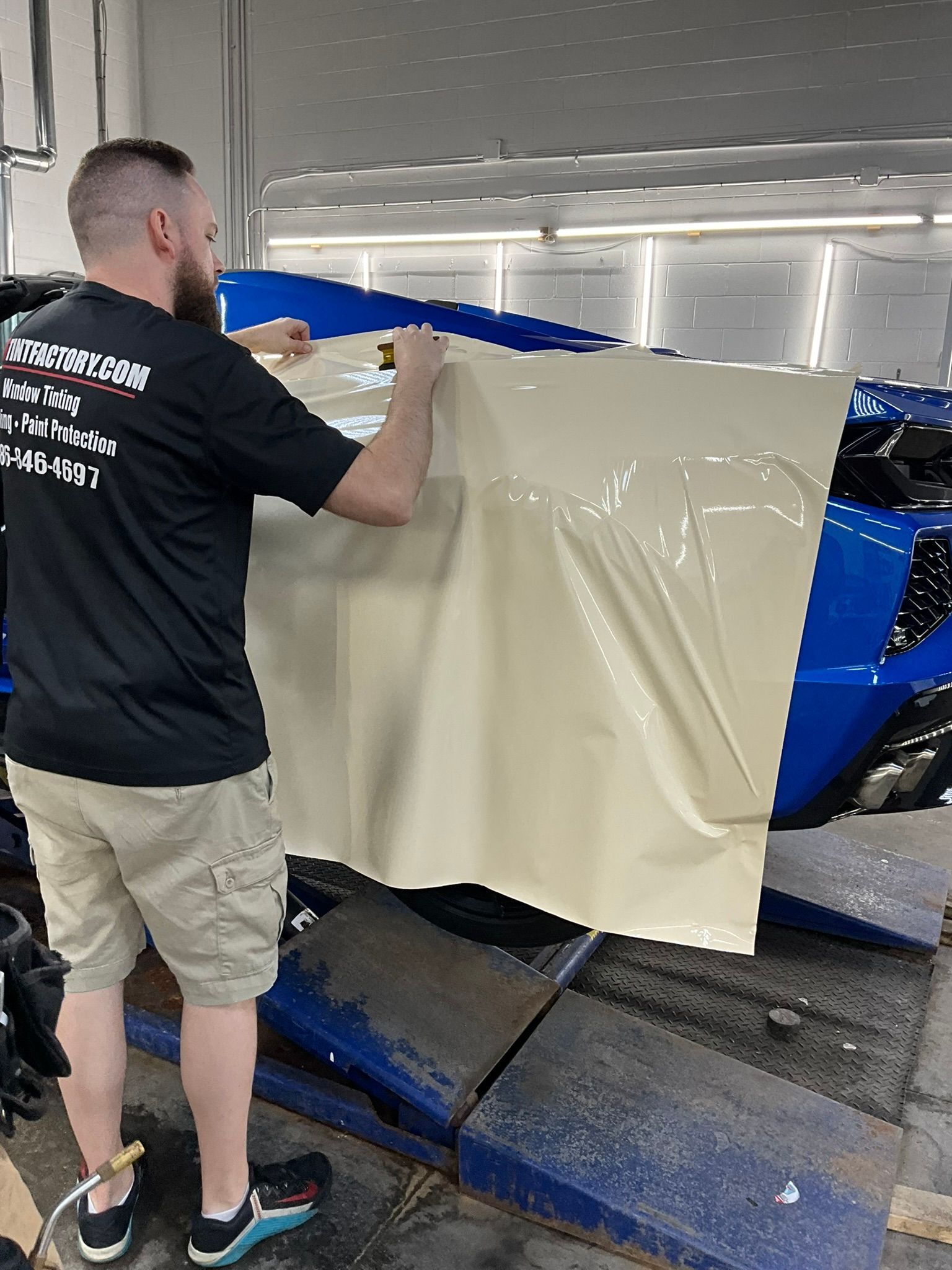
Man covering blue machinery with beige plastic sheeting in a workshop
By Shawn Winters June 1, 2025
When it comes to protecting your car’s paint, you have more options than ever before. Two of the most popular choices are Paint Protection Film (PPF) and Vinyl Wrap, but which one truly offers the best protection for your vehicle?
By Shawn Winters May 26, 2025
If you’ve ever inspected your vehicle after a road trip and spotted tiny chips, scratches, or mysterious scuff marks, chances are you’ve been on the receiving end of road debris. From loose gravel to sand, salt, or even rubber fragments, these hazards are constantly lurking on highways, construction zones, and rural backroads.
By Shawn Winters May 15, 2025
Water spots on a car’s surface can be frustrating, especially when you’ve invested in a ceramic coating to protect your paint.
By Shawn Winters May 15, 2025
Imagine driving your freshly detailed car through the rain, only to see water bead up and roll right off the surface. No water stains, no lingering grime—just a spotless, glossy finish.
By Shawn Winters May 9, 2025
When it comes to selling your car, every detail matters. Whether you’re trying to increase appeal, improve performance, or boost resale value, the choices you make today can impact how much you’ll get for your car down the line.
By Shawn Winters May 3, 2025
For any fleet manager, maintaining a large number of vehicles can be a constant challenge. Whether it’s ensuring the vehicles are operating smoothly or keeping them looking presentable, it’s no secret that the appearance of your fleet can impact your business’s image.
By Shawn Winters April 30, 2025
Your car isn’t just a mode of transportation—it’s an investment. Whether you drive it daily or keep it in pristine condition for resale, protecting its interior from wear and tear should be a top priority.
By Shawn Winters April 28, 2025
Your car’s paint isn’t just about looks—it’s the first line of defense against the elements. Sun exposure, road grime, bird droppings, and even improper washing techniques can dull its shine and lead to long-term damage.